
Role: Head of Product Design
Designing real-time guardrails for fair and compliant interviews
Shifted interviews from post-interview review to real-time guidance, reducing bias and legal risk.
FOCUS: Product strategy | Real-time AI | Behavioural Systems | Risk and compliance
.jpg)
Product context
The reality of the interview process
Intertru offered tools to transcribe and analyse interviews after they were done. However, the most important hiring decisions and the biggest risks happened during the live interview.
Interview quality varied a lot based on the interviewer’s experience. People went off script, asked different follow-up questions, and used different criteria, which made outcomes less fair and harder to compare.
Why the existing controls didn't work
Interview quality depended heavily on the interviewer. Interviewers often went off script, follow-up questions were inconsistent, and evaluation criteria varied. In some cases, sensitive or legally risky questions were asked. Training also worked unevenly across organisations.
Tools like post-interview transcription could highlight problems, but they couldn’t prevent them. By the time issues were found, the risk had already happened.
Since bias and legal risk showed up during the interview, the product needed to support interviewers in real time, not after the fact.
Key insight
Bias and legal risk weren’t post-interview problems, they emerged during the live conversation.
Interviews shape hiring decisions as they happen. If we wanted better results, the product needed to help during the interview, not just review it later.
By building structured guidance into the workflow, we moved from reviewing interviews after the fact to supporting interviewers in real time. This reduced bias and legal risk while keeping interviewer flexibility.
Product decisions
1. Introduced structured interview guardrails
Interviewers frequently deviated from scripts, creating inconsistent candidate evaluation and uneven hiring standards.
Rather than relying on training alone, I introduced a guided interview workflow that required three actions before progressing:
1. Ask the structured question
2. Capture notes
3. Record a rating
This embedded consistency directly into the live experience.

Why it matters:
Created comparability across candidates and reduced variability in interviewer behaviour without removing flexibility.
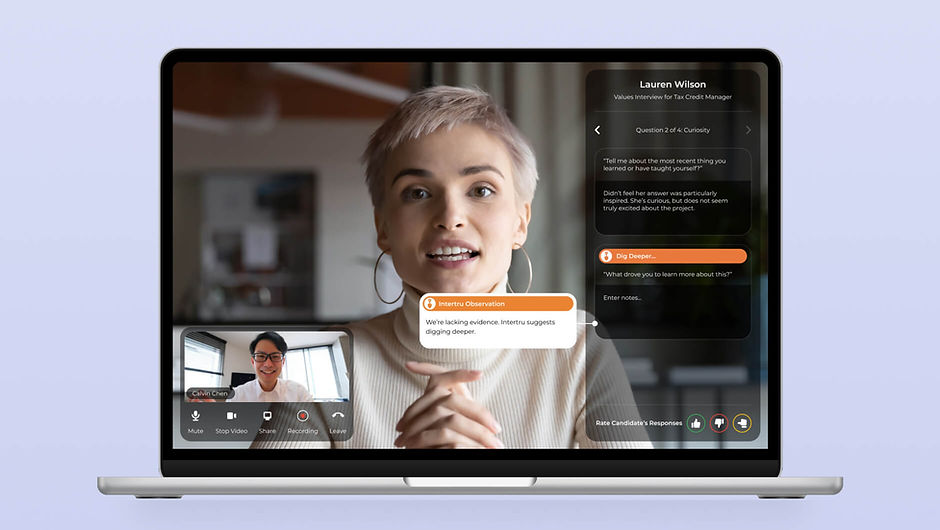
2. Embedded real-time “Dig Deeper” prompts
Interviewers often struggled to know how to respond when answers were vague or incomplete.
I added real-time guidance that suggested follow-up questions based on the candidate’s answers and the hiring criteria.
This reduced reliance on interviewer judgment and made the process more consistent.

Why it matters:
Improved interview depth and reduced reliance on interviewer skill level, making structured evaluation scalable.
3. Live legal intervention during interviews
Sensitive or illegal questions put companies at legal and reputational risk.
The platform watched for these types of questions and stepped in as soon as one was detected. Early tests showed subtle warnings weren’t enough, so we changed the design to stop the interview and show clear guidance on what to do instead.

Why it matters:
Reduced legal risk during interviews, not after the fact, and helped set the product apart as a compliance-first solution.
4. Market validation
We ran two focus groups with HR leaders and hiring managers to test the idea. They confirmed that interviewer inconsistency and legal risk were common problems, not rare edge cases.
We also worked with legal to fine-tune when the system should intervene and what it needed to do.
The first version didn’t perform well in testing, so we iterated. The improved version strengthened the product’s compliance story and helped position Intertru as a real-time coaching platform in sales conversations.

Click the image for full view.
Product impact
Operational change
Interviews moved from reactive review to structured, real-time guidance. Evaluation became more consistent, reducing variability across interviewers.
Risk mitigation
Bias and legal risks were mitigated during the live conversation rather than after the interview. This reduced exposure and strengthened our compliance posture
Product differentiation
Embedding guardrails and live legal intervention directly into the workflow repositioned Intertru as an intelligent interview system rather than a passive evaluation tool, strengthening its competitive advantage.
